

Almost every company we work with has faced the same problem: four posts at the start, momentum, comments. Then the following month goes quiet. It is not a motivation problem, and it is almost never a lack of ideas. It is that, for every post, everything had to be reinvented: the topic, the angle, the tone, the visual, the timing. After three weeks, the blank page wins.
An editorial line exists for exactly this: removing the blank page. It does not make content more brilliant; it makes producing it possible, week after week, with the people and the time you really have.
Why consistency matters more than volume
A company that publishes once a week for a year creates fifty-two opportunities to be found, read and remembered. A company that publishes four times a week for a month creates sixteen, then disappears — and an abandoned account says something about the business to whoever discovers it six months later.
Consistency has another, less visible effect: it teaches you. After ten posts in the same series, you know which topics bring questions and which go unnoticed. After three scattered posts, you know nothing.
The right rhythm, then, is not the maximum rhythm. It is the one you can still keep up in December, during a busy month, with a team member away.
What an editorial line is — and what it is not
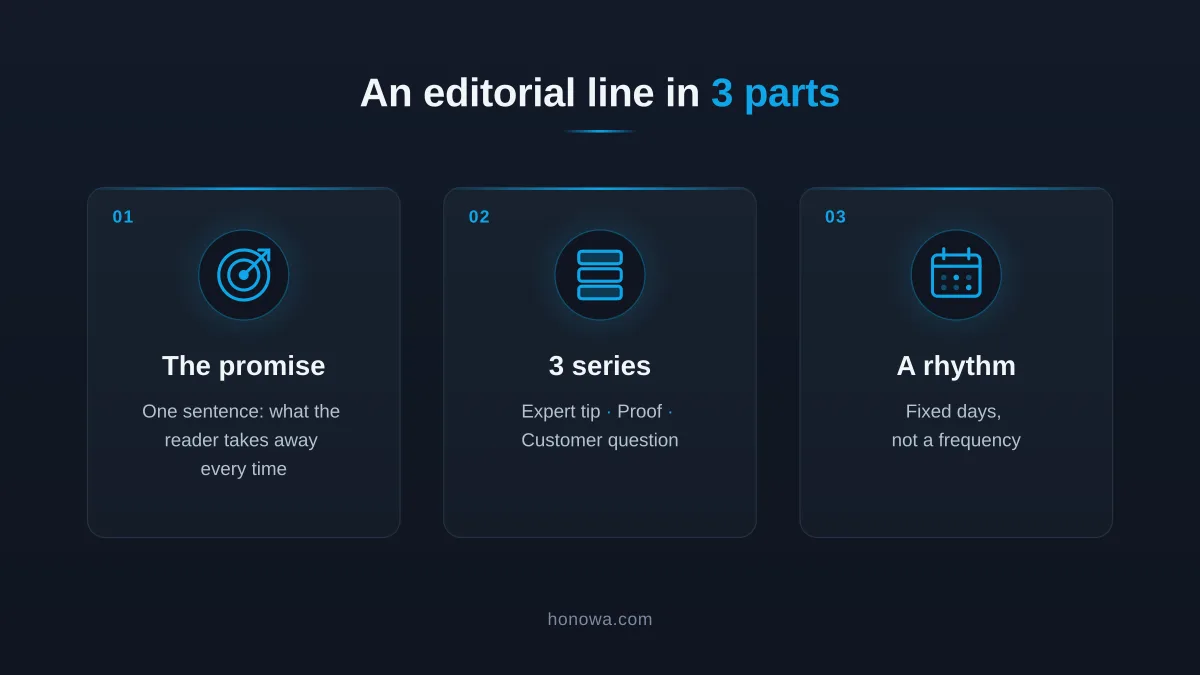
It is not a calendar filled six months ahead: nobody sticks to one. Nor is it a brand style guide or a list of hashtags. An editorial line is a decision framework in three parts: a promise, series and a rhythm.
A promise
One sentence stating what your reader takes away, every time. For example: “every post leaves the reader with an idea they can apply in their business, a verified fact, or a proof”. This sentence works for you: it settles topics without a meeting. A topic that keeps none of the three promises does not get published.
Three or four series
A series is a slot to fill, instead of a topic to invent. For an SME, three series are almost always enough:
- the expert tip: what you explain ten times a month on the phone;
- the proof: a project, a before/after, a customer who agrees to be named;
- the customer question: a real question received this week, and its answer.
The benefit is mechanical. Faced with a series, you are not looking for a topic: you are looking for the next example. That is a much easier task, and it can be delegated.
A rhythm and time slots
Write down days, not a frequency. “Tuesday and Thursday” holds; “two to three times a week” does not, because nobody owns the slot. If only one person writes, one slot a week is already good.
Building it in one afternoon
Three hours are enough for a first usable version. It will be corrected after two months, with facts. Here are the five steps.
1. Write the promise
One sentence, not a paragraph. Have someone who does not work with you read it: if they cannot infer what you will publish next week, it is too vague.
2. List the questions you are really asked
Open your messages, your business WhatsApp conversations, this week's calls. Write down twenty questions, as they were asked, in the customer's own words. That is your topic reserve for six months, and it is also material for search: these phrasings are the ones your customers type.
3. Group them into three or four series
The twenty questions almost always sort themselves. Name each group simply, with a name your team will actually use.
4. Choose a sustainable rhythm
Two questions: who writes, and when? If the answer is “we'll see”, the rhythm does not exist. Block a writing slot in that person's calendar, just like a client meeting.
5. Decide where you publish — and where you don't
Two channels kept alive are better than accounts opened on five platforms and active on one. Choose based on where your customers are, not where your competitors are. And write differently for each channel: a text copied and pasted from one platform to another is spotted immediately.
Measuring without paid tools
An editorial line is corrected with facts, and the first facts are free.
Your Google Business Profile already counts, for verified profiles, the searches through which people found you, views, calls made from the call button, website clicks, direction requests and messages received. Search terms are updated at the start of each month, with a delay of up to five days. That is more than enough to see whether your posts generate contacts.
Look at three things, once a month: the number of posts actually published, the questions received by private message, and the calls. Not the likes. To go further, our article on the three metrics that matter for your online presence details the method.
Three mistakes that bring an editorial line down
Wanting to announce everything. An editorial line that only talks about your offers runs dry, because your offers do not change every week. Keep promotion in the minority: most posts should inform, explain or prove.
Confusing a calendar with an editorial line. A calendar filled by one person, in one evening, dies with their motivation. Series, on the other hand, survive absences.
Changing course every fortnight. Two months without visible results do not mean the line is wrong: often, it simply has not been kept long enough to produce anything yet.
In short
- A one-sentence promise.
- Three named series.
- A rhythm you will keep up in December.
- Two channels, not five.
- Three metrics checked once a month.
It is less appealing than a colour-coded six-month calendar, but it will still be publishing next spring.
If you would like us to review your online presence together and build this editorial line with you, write to us: we will tell you what is feasible with the time your team has. You can also explore our digital marketing and SEO services.
Frequently asked questions
What is an editorial line?
A decision framework in three parts: a promise (what the reader takes away from every post), three or four content series, and a rhythm set on specific days. It is neither a calendar filled six months ahead nor a brand style guide.
How often should an SME publish?
At the pace it can still keep up in December, during a busy month, with a team member away. If only one person writes, one post a week is already good: consistency matters more than volume.
Which content series should an SME choose?
Three series are almost always enough: the expert tip (what you explain ten times a month on the phone), the proof (a project, a before/after, a named customer) and the customer question (a real question received this week, and its answer).
How can you measure an editorial line without paid tools?
Once a month, look at three things: the number of posts actually published, the questions received by private message, and the calls. Your Google Business Profile already counts views, searches, calls, clicks and direction requests.
Which mistakes make an editorial line fail?
Talking only about your offers, confusing a calendar with an editorial line, and changing course every fortnight before the line has been kept long enough to produce results.
Honowa Technologies SARL
Makepe, Douala, Littoral
Cameroon.
Source: Google Help Centre, "Business Profile performance metrics" (support.google.com, accessed 8 October 2026).
Author: Michèle Njikam, Digital Marketing Manager @ Honowa Technologies